The ear lobule is a small, humble piece of tissue. No muscle. No bone. No cartilage. Just a blob of fat wrapped in skin.
And yet, for most women, an ear without an earring is unthinkable. For some, the ears carry earrings from the top of the helix all the way down to the lobule. Stacked, layered, multiple. It looks beautiful. It is beautiful.
But there is a silent story behind it.
What the lobule actually is — and what it isn't
The lobule has no structural support. It is not designed to bear weight. It has a limit — and when that limit is crossed repeatedly, over months and years, the tissue begins to give way.
The piercing hole stretches. Slowly at first, then more noticeably. The opening that was once a neat, small puncture becomes a long vertical slot. And then, one day — with a heavy earring, a sudden pull, or sometimes nothing dramatic at all — it tears. The lobule splits.
This is not a failure of the person wearing the jewellery. It is simply the biology of a tissue that was never built for what we asked of it.
The three presentations a surgeon sees
Most patients arrive with one of three problems.
The earring no longer sits properly — it droops, slides, or falls out. The hole has stretched enough that wearing anything looks wrong.
Partially or completely. Sometimes it happened suddenly. Sometimes it crept along over time until the tissue finally gave way.
A large, deliberate stretching of the tissue — sometimes to significant size. The patient now wants it closed.
Each of these is different in appearance. The surgical approach varies. But the principle is the same — bring the tissue back. Repair what has been damaged.
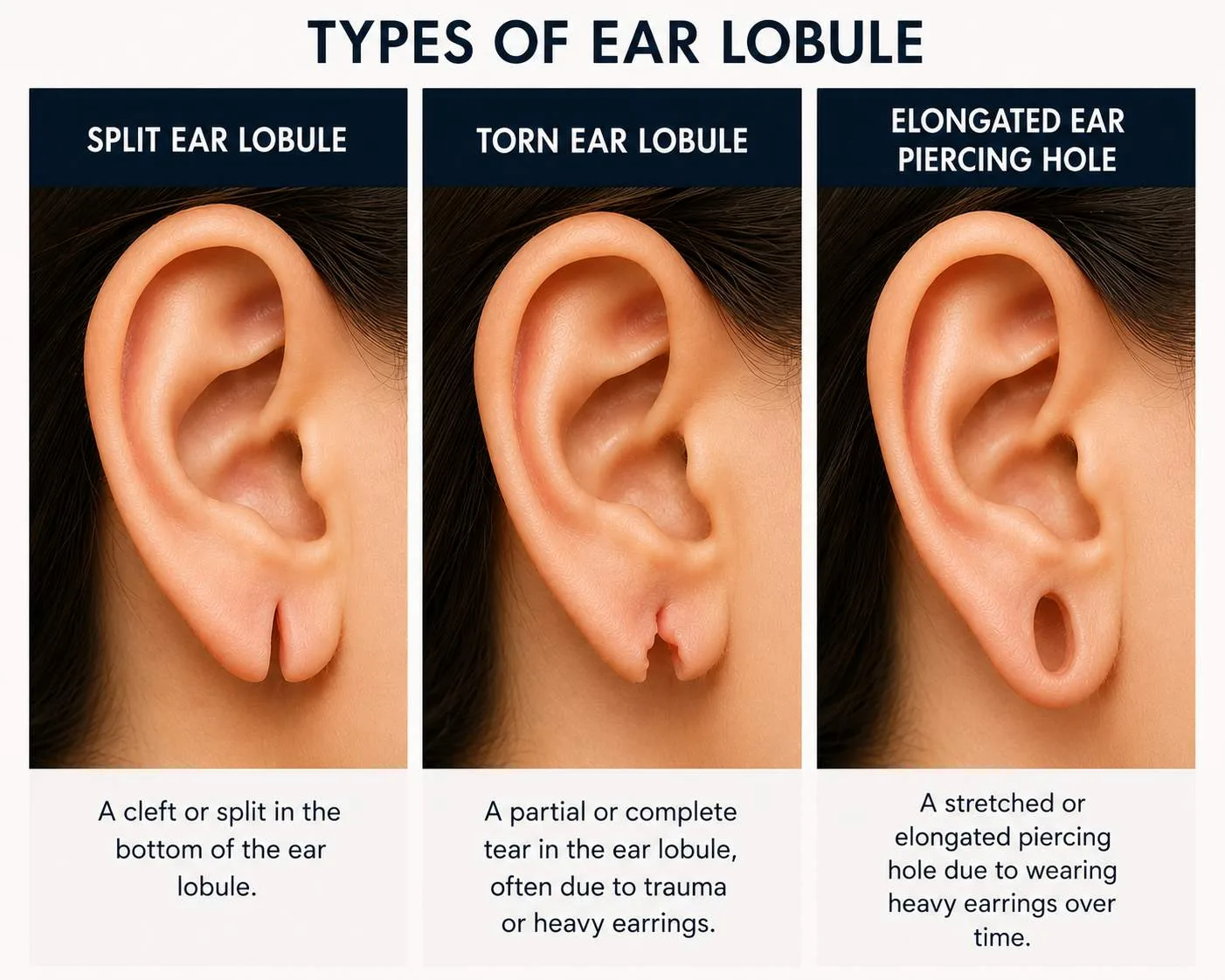 The procedure
What surgery involves
From a surgical standpoint, lobuloplasty is a relatively straightforward procedure.
No hospital admission. No general anaesthesia. It is done under local anaesthesia in a minor operation theatre and the patient goes home the same day.
The damaged or stretched tissue is incised and the edges freshened. The wound edges are then repositioned and brought together, and finally sutured to recreate the lobule. Sometimes a small opening is maintained or created afresh, so that an earring can be inserted at the same time.
No separate re-piercing procedure later on. You leave wearing an earring. The earring must be small and lightweight — gold is preferred.
This is not something offered everywhere. It is standard practice here.
Gauged earlobe — honest expectations
Gauged earlobe repair follows the same surgical principles, with some technical differences depending on how large the hole is.
A large gauge hole will not close on its own. Surgery can close it. But patients need to understand — there will be a scar, and there will be some degree of indentation. How much depends on how large the gauge was. The goal is a natural, neat appearance — not a perfectly identical earlobe.
Immediate earring insertion is not preferred for gauged earlobe repair.
What if a previous repair has failed?
Repair failure happens. A failed repair does not mean the lobule cannot be fixed. It means the revision needs to be handled more carefully. Revision lobuloplasty involves more complex tissue management than a primary repair. It requires understanding of wound behaviour and scar tissue. This is plastic surgery territory — and a plastic surgeon is the right person to manage it.
A few things patients ask
Not always immediately. But if the hole has stretched to the point where earrings no longer sit properly, or it is impossible to wear anything properly, it needs to be corrected. The hole is less likely to tighten on its own if you continue to wear earrings.
A small, recently stretched hole may partially reduce with time. A significantly elongated or split lobule will not close on its own.
Yes — a fine scar along the repair line. The scar settles by 3 months. Heavy earrings are not advised during this period — only very lightweight earrings may be considered. In gauged earlobe repair, some indentation is also expected.
For split and torn earlobe repairs where earring insertion is done at surgery — immediately. This is done on a case to case basis. The earring must be small and lightweight. For others, once the wound has healed and the scar is sufficiently strong — assessed at examination, not by a fixed number of weeks.
₹3,000–₹5,000 per earlobe at Lakeshore Hospital, Ernakulam. Both sides can be done in one sitting. Final cost may vary after examination and hospital billing.
One last thing
The lobule is small. From a biological point of view, it doesn't serve any function. But for a social human being, it's everything.
Inability to wear an earring is a social trauma — poking you when you look at the mirror or when you go out. Please understand there is a solution.
The procedure is minor. But for the person who has been avoiding earrings for months, covering a split with longer hair, or simply living with something that bothers them every time they look in the mirror — it matters.
It is worth fixing. And it is fixable.