Most people who come to us for rhinoplasty in Kochi use the more common term — "nose job." Many are already well informed. They have spent hours reading online, looking at before-and-after photographs, watching videos, and perhaps consulting a few surgeons in Kochi or elsewhere in Kerala. But all of that information is usually from a patient's perspective.
If you are considering rhinoplasty in Kochi, you have probably wondered: can my nose really change that much? Will rhinoplasty suit my face? Can I get a nose like a celebrity? Is surgery worth it? These are valid questions. But before we talk about surgery, techniques, recovery, or costs, there is something far more important — the quality of information that comes from you. The better you and your surgeon understand the problem, the better the planning and ultimately the result.
Before anything else
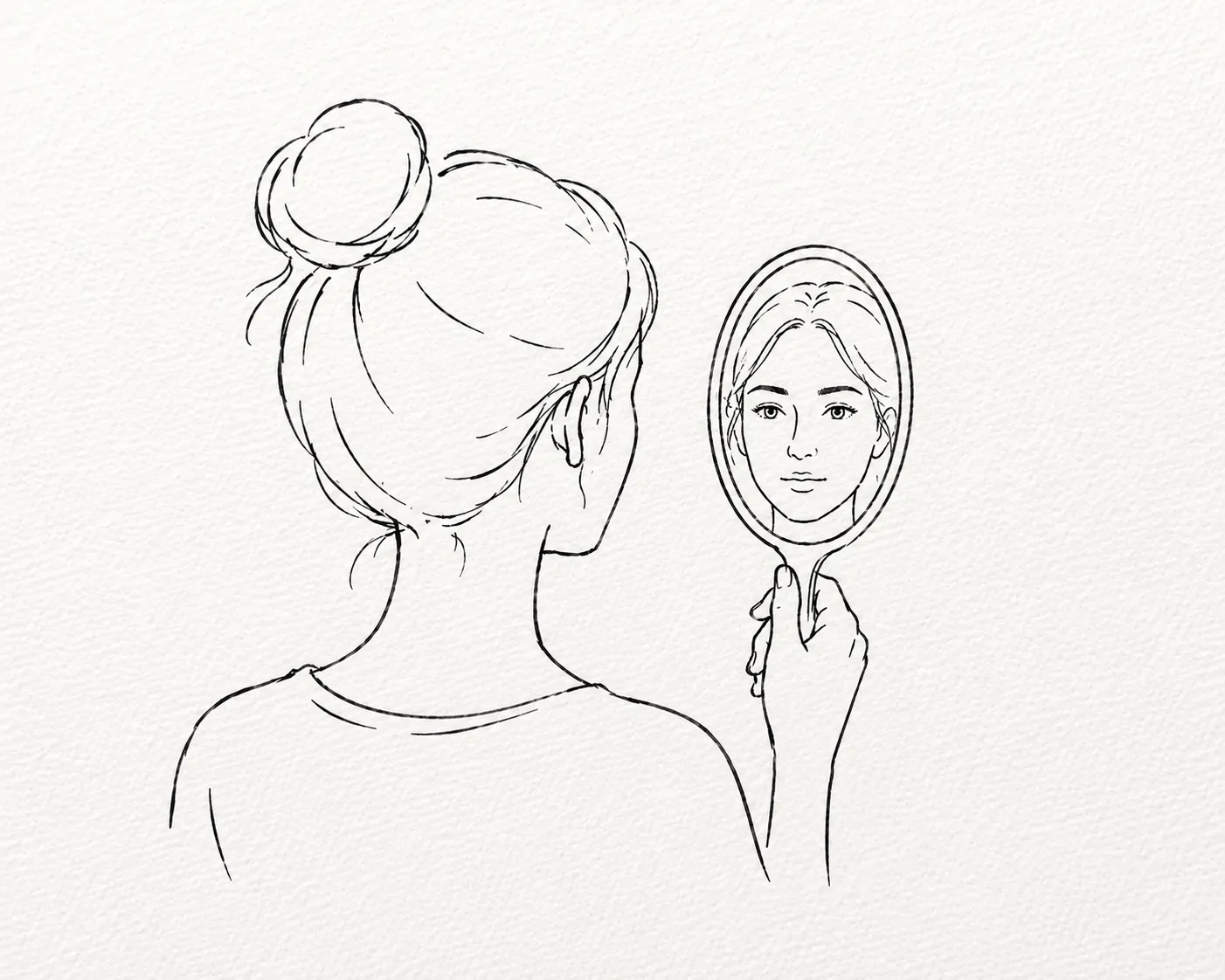
How good is your mirror?
Most people judge their nose using a bathroom mirror. The problem? A mirror shows only one perspective — and that too skewed, because top lighting creates different shadows and reflections from the lighting in a room or outdoors.
Think about it. How many of your colleagues, friends, relatives, or even your partner spend their day looking straight at your face? Almost nobody. Most people see you from an oblique view, a side profile, a three-quarter angle, or while you are talking or smiling. The view you see in the mirror is often the view other people see the least.
Before considering rhinoplasty, take a closer look at yourself from four angles:
The view you usually see — but with balanced light, not top-lit bathroom lighting.
Both sides. Most faces are not perfectly symmetrical, and neither are most noses.
The three-quarter angle — the most common view other people actually have of you.
Some nasal changes — a drooping tip, for example — only appear with facial movement.
You may be surprised. Many patients discover that the feature bothering them in the mirror is not actually what stands out from other angles. Sometimes this exercise alone changes a patient's perspective completely. After doing this, some people realise they don't need rhinoplasty at all — and that saves time, money, stress, and an unnecessary operation. If the concern remains and continues to bother you, then attending a rhinoplasty consultation is the right next step.
What should I tell my rhinoplasty surgeon?
The simple answer is this: tell us what bothers you. Not what your friend thinks. Not what social media thinks. What bothers you when you look at yourself.
"I don't like my nose" should not be your final answer. Try to identify the specific concern:
- → A dorsal hump — the ridge along the bridge
- → A wide nose when seen from the front
- → An S-shaped or collapsed bridge
- → A bulbous tip
- → A drooping tip when you smile
- → A crooked nose
- → Uneven nostrils
The more specific you are, the easier it becomes for your surgeon to understand your goals — and to determine whether they can be achieved safely.
What actually happens at a consultation
What a rhinoplasty consultation actually is.
Many patients think a consultation is simply about finding out the cost of surgery. It isn't. A proper rhinoplasty consultation involves evaluating facial proportions, skin thickness, cartilage strength, nasal symmetry, airway function, previous injuries, and previous nasal surgeries. More importantly, it involves breaking down your concerns and explaining what is possible, what is not, how those goals can be achieved, and what compromises may be required.
"A good consultation is less about choosing a new nose and more about understanding what changes are realistic for your face."
— Dr. Sinnet RoyCan I show photos during my consultation?
Absolutely. Photographs are often one of the most useful tools during rhinoplasty planning. Bring photos of yourself that you like, photos of yourself that you dislike, and examples of noses you find attractive.
However, the purpose is not to copy someone else's nose. The purpose is to understand your preferences. A nose that looks attractive on one face may look completely out of place on another. Our goal is not to replicate another person's nose — it is to understand your concerns and create a result that suits your face.
Am I a good candidate for rhinoplasty?
You may be a suitable candidate if you are bothered by the appearance of your nose, facial growth is complete, you are in good general health, you have realistic expectations, and you understand the recovery process.
The best candidates are often not those seeking perfection. They are the ones seeking improvement. That distinction matters more than most patients realise — it shapes the entire surgical plan and the assessment of what counts as a good result.
Be honest about breathing problems.
Patients often focus entirely on appearance and forget to mention functional concerns. Tell your surgeon if you have nasal blockage, difficulty breathing through one side, mouth breathing during sleep, allergies, previous nasal fractures, or previous nasal surgery. These details affect both the surgical plan and the expected outcome.
Can rhinoplasty improve breathing as well as appearance?
Yes. In many patients, functional rhinoplasty or septorhinoplasty can improve both appearance and breathing. Modern rhinoplasty is not simply about creating a prettier nose. A beautiful nose that cannot breathe properly is not a successful outcome.
How much can your nose realistically change?
One of the biggest misconceptions about cosmetic surgery is that every nose can be transformed into any desired shape. We cannot give you the exact shape in your mind. There are limits. The final result depends on skin thickness, cartilage structure, bone anatomy, ethnicity, previous surgeries, and individual healing characteristics.
"Your preferences are extremely important. But rhinoplasty is always limited by anatomy. A responsible surgeon should explain both what can be achieved and what cannot."
— Dr. Sinnet RoyCan I choose the exact shape of my new nose?
No. Rhinoplasty is always limited by what your anatomy allows. The goal is not perfection — the goal is harmony. Your nose should complement your eyes, lips, chin, forehead, and overall facial proportions. The best rhinoplasty results are usually the ones that don't immediately look operated on.
Will rhinoplasty suit my face?
Almost every patient asks this. A successful rhinoplasty often attracts attention to the face as a whole rather than to the nose itself. When done well, people notice something looks better — they rarely notice the nose specifically. That is the goal.
Can rhinoplasty make my nose smaller?
Often, yes. But smaller is not always better. Removing too much cartilage or bone can result in breathing difficulties, structural weakness, and an unnatural appearance that becomes more pronounced over time. The objective is balance, not simply reduction.
Can a crooked nose be corrected?
In many cases, yes. A crooked nose may result from trauma, congenital asymmetry, or previous surgery. However, facial asymmetry is common and perfection is rarely possible. Improvement is often a more realistic goal than absolute symmetry.
Can rhinoplasty fix a droopy tip?
Yes. A drooping nasal tip is one of the most common concerns addressed during rhinoplasty. The tip can often be refined, supported, and repositioned to create a more balanced appearance while maintaining a natural look.
What to avoid before rhinoplasty.
Your surgeon may advise avoiding smoking, nicotine products, certain herbal supplements, blood-thinning medications (only after medical advice), and excessive alcohol consumption. These factors can affect healing and increase complication rates. This is not a generic checklist — each of these has a specific physiological reason behind it.
Recovery
What to expect after rhinoplasty.
Most patients are surprised by the answer on pain. Pain will not be what bothers you most. Rhinoplasty is usually less painful than expected — recovery is more commonly associated with nasal congestion, swelling, and pressure rather than severe pain.
Patients who become concerned about their result at three or four weeks are almost always looking at swelling, not at the final shape. The tip, in particular, takes the longest to settle. If you had rhinoplasty and are worried about the outcome, speak to your surgeon — but understand that the nose you have at four weeks is not the nose you will have at twelve months.
Costs
How much does rhinoplasty cost in Kochi?
The cost of rhinoplasty in Kochi is not a single figure. It depends on several variables — and a formal consultation is the only way to get an accurate estimate for your specific case.
- → Complexity of the surgery
- → Whether breathing correction is included
- → Primary versus revision rhinoplasty
- → Hospital facilities and room type (ward, single, double, AC — rates differ)
- → Number of days admitted
- → Other surgeons involved
- → Devices or implants used, if any
Rhinoplasty is widely considered one of the most technically demanding procedures in plastic surgery. The variation in cost between surgeons reflects differences in surgical experience, hospital facilities, and the complexity of your individual anatomy. A lower price does not mean a better deal if the surgical planning is inadequate.
Revision rhinoplasty is generally more expensive than primary surgery. The surgeon must work around scar tissue, altered anatomy, and sometimes limited cartilage availability. Operating in a nose that has already been surgically changed requires more planning, more time, and sometimes cartilage grafts from other sites. All of this adds to the cost.
What your surgeon actually needs from you.
I don't need you to learn about surgical techniques. But you need to understand the limitations of surgery in general — and what it can realistically deliver for your face specifically.
Your surgeon needs to understand what bothers you about your nose, what outcome you hope to achieve, whether you have breathing concerns, what "natural" means to you, and what changes you definitely do not want.
Most importantly, we need to establish whether surgery is actually capable of delivering the result you are hoping for. The best rhinoplasty results happen when patient expectations and surgical planning align.
If you are considering rhinoplasty, septorhinoplasty, or nose reshaping surgery in Kochi, preparing for your consultation with clear goals and realistic expectations may be just as important as the surgery itself.
This article is written for general educational purposes by Dr. Sinnet Roy — not as clinical advice for any specific individual. If you are considering rhinoplasty, a formal consultation is the appropriate first step. For procedure-specific information, see the rhinoplasty procedure page or read about a related facial procedure such as blepharoplasty.